
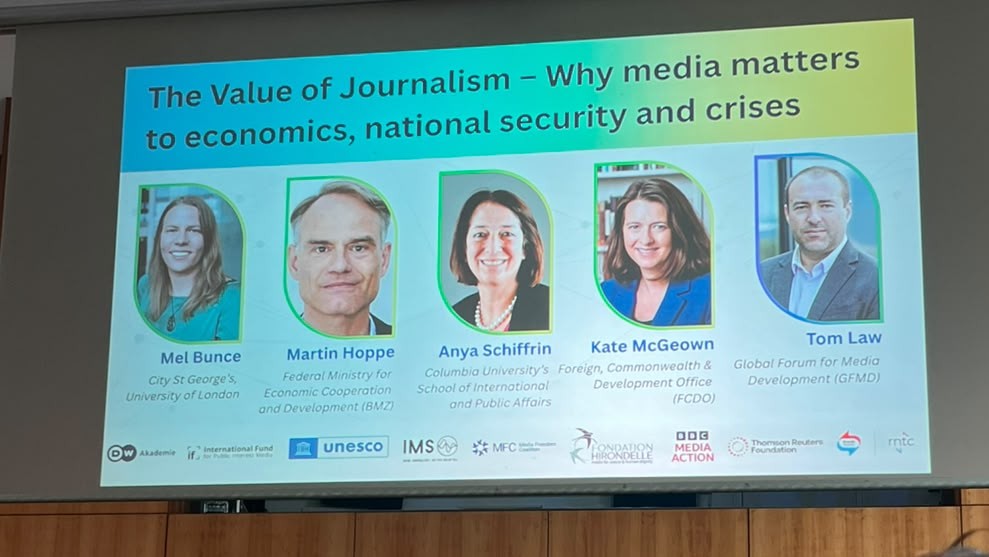
The Value of Journalism Report was launched at the Global Media Forum in Bonn in June, 2026. (Photo: Sophie Smit)
A comprehensive analysis of multiple existing studies that provides compelling indications of the value of journalism as a public good has been released at the Global Media Forum in Bonn.
The new meta-study, Value of Journalism is published at a precarious time for independent media. It explains why ongoing newsroom cuts and persistent attacks on the media have reduced the amount of reliable and independent journalism available to audiences worldwide.
The study supports the fundamental acknowledgment that “independent journalism is a vital public good” and the bedrock of democratic governance, which lies at the heart of the M20 Johannesburg Declaration.
The M20 declaration warns that a “business-as-usual” approach will result in catastrophic collapse of information ecosystems, creating “drastic threats to economic, safety and overall civil stability”, as outlined in a summary of the live declaration, which to date has more than 66 signatories.
The declaration is designed to push for G20 leaders to integrate information integrity, press freedom, independence, and media sustainability into the world’s “broader development financing architecture, including commitments under the Global Digital Compact”.
The Value of Journalism report, authored by Mel Bunce and Beth Pearson from City St George’s, University of London, builds on these processes and frameworks.
The pressures on journalism is starkly illustrated in the recently published 2026 World Press Freedom Index by Reporters Without Borders (RSF), which shows that only 1 percent of the world’s population now lives in countries where press freedom is rated as “good.” For the first time in the index’s 25-year history, more than half of all countries fall into the two lowest categories, “difficult” and “very serious”, note the Value of Journalism commissioners, DW Akademie, International Fund for Public Interest Media (IFPIM) and UNESCO as members of the Research Working Group of the Media Viability Manifesto Initiative.
Summary overview of findings
- Journalism is an economic enabler: A robust study of 97 countries shows that when a country declines in press freedom on the World Press Freedom Index, there is an associated 1-2 percent reduction in real GDP growth – and that this is slow to recover.
- It also found that investigative journalism delivers strong returns – Every $1 spent on journalism can result in more than $100 in savings to the public through reclaimed funds, improved public services and reduced corruption.
- It also found that journalism supports national security and reduces conflict and rights violations. A study of 152 countries associated greater access to free media with a reduction in human rights abuses.
- Journalism provides information that saves lives. A study of more than 2,300 disasters showed that a single news story in the New York Times generated an additional $500,000 in official aid.
Global South research findings
Drilling down specifically on Global South references, which are typically neglected in research studies, the report notes:
- Journalism insulates audiences from disinformation: A study tracking the online news consumption of 2,200 internet users in Brazil, included four waves of surveys asking respondents about their belief in disinformation. The researchers found that the more a respondent accessed legacy news sources, the less likely they were to believe in false rumours. These findings were corroborated in a study of 4,732 participants in Brazil, India and the United Kingdom that showed news consumption helps people become more informed and more resilient to disinformation.
- Journalism motivates audiences to engage politically: A large experimental study in Mozambique found that the distribution of a free newspaper led to voter turnout increasing by five percent.
- Journalism incentivises elites to act in the public interest: A study in India found that the expectation that newspapers would publish performance ‘report cards’ led to electoral candidates placing greater emphasis on pro-poor spending in high-poverty areas.
To download the Value of Journalism report, click here.