Summary: The M20 Johannesburg Declaration – An evolving global shield for information integrity
The M20 Johannesburg Declaration stands as a definitive call to collaborative action in an era defined by the runaway expansion of Artificial Intelligence and shrinking capacity of global newsrooms, with adverse effects on the world’s information ecosystem.
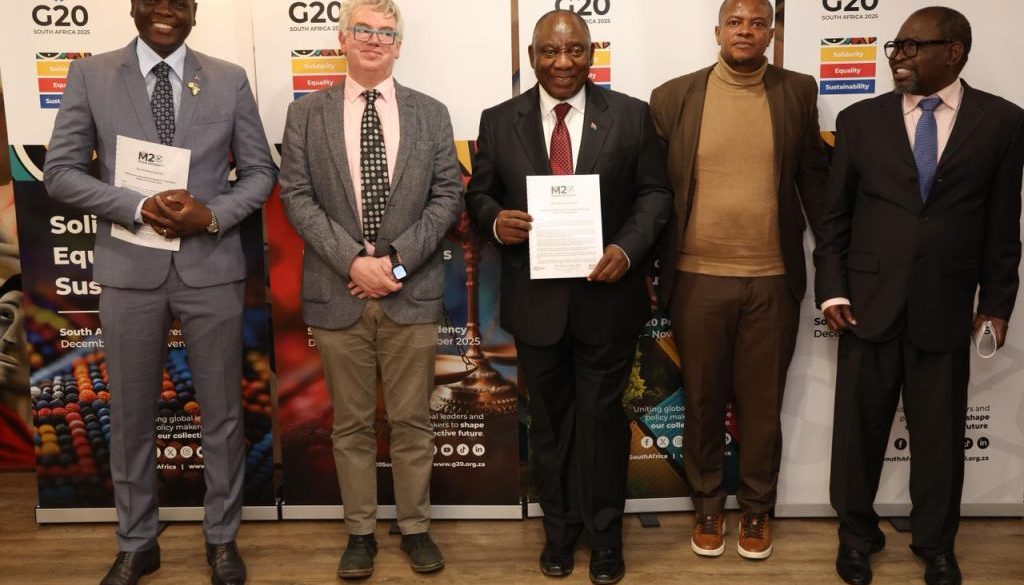
Local and international media representatives convened in Johannesburg for the inaugural M20 Summit in September 2025 to issue an urgent alarm about a “profound global crisis in the integrity of information, peace, and respect for human rights”.
The declaration, which was finalised at the summit, provides a framework for ongoing advocacy, information-sharing and engagement. It is designed to push for the G20 to integrate information integrity, press freedom, independence, and media sustainability into the world’s “broader development financing architecture, including commitments under the Global Digital Compact”.
To date, the M20 represents a unified front of 66 organisations — and counting — dedicated to ensuring the pillars of democracy and human rights are no longer sidelined in the ever-evolving digital space.
The declaration makes targeted calls upon media and partners, and then upon G20 leaders, to take urgent steps to respond to this crisis.
Journalism as a vital public good
At the heart of the declaration is the fundamental acknowledgment that “independent journalism is a vital public good” and the bedrock of democratic governance. The M20 warns that a “business-as-usual” approach will result in catastrophic collapse of information ecosystems, creating “drastic threats to economic, safety and overall civil stability.”
Functioning as a parallel, autonomous track to the G20 — which was hosted by the South African presidency in 2025 — the M20 recognises that the collapse of journalism revenue models is “symptomatic of broader market failure”, including market concentration in digital advertising and distribution, and cannot be solved by innovation alone. It cites “platform dominance, unchecked data extraction and algorithmic bias” as systemic issues requiring urgent policy responses such as competition measures, transparency requirements, and public-interest funding models comparable to those supporting other public goods.
The twin challenges: AI and digital dominance
The M20 highlights a “downward spiral” where disinformation is amplified by AI algorithms and reintegrated as training data for newer models. To counter this, the declaration calls for journalists to reframe AI as “a story about power, not just technology and hype”.
Key recommendations to global leaders include:
-
Accountability: Holding tech companies accountable for the “design of their AI tools” and their impact on news integrity.
-
Fair Compensation: Establishing clear copyright and compensation rules for journalistic content scraped by AI companies.
-
Global South Inclusion: Ensuring AI frameworks support linguistic and cultural diversity to prevent the marginalisation of indigenous languages, including investment in local-language datasets and equitable access to AI infrastructure
-
Strengthening Independence: Prioritising initiatives to preserve the vital role of media, in line with commitments 35(b) and (c) of the Global Digital Compact.
-
Sustainable Funding: Developing public funding mechanisms with strong guarantees of editorial independence and universal access to reliable information.
-
Building Peace and Democracy: Promoting environments where free, plural, and independent media can thrive to reinforce democratic governance and social cohesion.
-
Data Access: Enabling secure, privacy-respecting access to platform data for independent researchers and journalists, and for public interest oversight. This builds on the M20’s platform accountability commitments and reflects subsequent policy developments that recognise that access to information must be fit for purpose and extend to data held by public institutions and dominant private platforms.
Safeguarding the messengers
The declaration is unyielding regarding the physical and legal safety of journalists, condemning “persistent impunity” for crimes against media workers, particularly in situations of armed conflict, in line with decision 35(f) of the Pact for the Future. Furthermore, the M20 calls for a global prohibition on the unlawful use of spyware against journalists and an end to the use of “criminal charges and strategic lawsuits against public participation” (SLAPPs) intended to silence watchdogs.
Equality, inclusion and future-proofing
The M20 places significant emphasis on mitigating the intersectional impact of inequality, with particular emphasis on gender. It also recognises the need to address exclusion based on disability, language and geography. And accordingly, it also adopted the Kigali Declaration’s goals to eliminate gender violence in the media. At the same time, the M20 urges for attention to be given to young people, and “child-rights-based safety standards” from digital platforms, and advocates for “age-appropriate child safety by design” to protect the next generation from predictive profiling and toxic information environments.
A roadmap for 2026 and beyond
The M20 provides a structure to track and publicly report on annual impact metrics through a proposed Media Integrity Monitoring Framework with measurable indicators on media independence, sustainability, safety, platform accountability, and AI governance, and an M20-linked Integrity Index.
Led by the South African National Editors’ Forum (SANEF) and Media Monitoring Africa (MMA, now called Moxii Africa) in 2025, the local organising baton was passed on to the United States for 2026, to be followed by the United Kingdom in 2027, with an international M20 Steering Committee, Advisory Group and Secretariat guiding the multi-year implementation of the M20 advocacy agenda.
This evolving initiative is a vital reminder to global leaders that “independent, economically viable media are indispensable to sustainable development”, and that these institutions must be recognised as essential public infrastructure within digital and economic systems.
Join the initiative
See the full declaration here.
Organisations wishing to get involved, and/or add their names to the list of endorsements, can reach out to the M20 Secretariat.
Email: [email protected]
Note: The building blocks for the M20 Johannesburg Declaration were grounded in a series of policy briefs published as part of the M20 process, which culminated in the endorsement of the Declaration at the inaugural M20 Summit on 1 and 2 September 2025. These steps follow previous media initiatives during G20 processes in Brazil (2024) and India (2023).